Tuesday, September 2, 2014

Dayak carved human skull

Dayak carved skull, Sarawak, Malaysia from 1900s. H 16cm, dia 17.5cm
I love guiding this human skull; mainly because it represents an important part of the belief system in Southeast Asia (SEA) and its very rare to have human remains in a museum. It's about 100 years old and is believed to be from the Kayan Dayak community hailing from Sarawak, the Malaysian part of the island of Borneo. Headhunting is the ritual act of taking a human head and had been prevalant in most of SEA communities for a few thousand years before the Europeans arrived here and banned it. It is a very complex subject and I am not going to get into it in depth or state any opinions on the ethical aspects surrounding it, but will present a very simplified view.

Dayak is the collective word given to the indigenous people of Borneo and it simply means inland or upriver. As the name suggests, most Dayak communities live along rivers and depend on it as well as the surrounding forest for their livelihood, so they form alliances with other groups living along the same river. Different communities have different beliefs around headhunting and perform different rituals so I am writing in very general terms. Dayak belief system was a mixture of ancestor worship and animism (from Latin animus meaning soul or life), which is the worship of spirits attributed to natural phenomenon and also inanimate objects. For example; thunder, lightening, earth, trees are said to have spirits. There are both good spirits and evil spirits but they have to be in harmony for the cosmos to be in balance. 

If there is an illness, disease or crop failure, the Dayaks believe that the cosmic balance is disrupted and evil spirits need to be appeased through rituals that require human sacrifice, mainly procuring heads of enemies. Why the human head? Some Dayaks believe that it contains the human soul (a very powerful spirit) and because it contains the face, it is a symbol of a human. The decision to procure a head was a serious one and the entire community made the decision together. Once the decision was made, a headhunting raid was organized and only men participated in it. It is also not to be confused with an act of war and the enemy victim was not a specific target but could be anyone. Once the victim was decapitated, the body was left behind (headhunting was not related to cannibalism) and the head was taken back to the village where it was treated with great respect. When the men returned from a successful raid, the women would welcome them home with songs and receive the victim’s head in a very special cloth called Pua Kumbu which is woven using the Ikat technique. This would imbue the cloth with magical powers of healing. After the raid, the men would get tattoos marking their participation, usually on their shoulders and fingers. 

Tattos showing he is a skilled headhunter, late 19th CE

Skill headhunter with 2 skulls and his sword around his waist
The head was usually smoked and kept in a very prominent place in a longhouse, which is a communal village house. It would be offered food and drink like eggs, rice, rice wine and these would be placed in a basket under the head. The reason for the offerings and ceremony was to entice the spirit contained in the head to become a friend of the community and work in their favour, and also to ward off the evil spirits, thus bringing prosperity to the community. Skulls are not normally carved so the one in ACM is very rare. Unfortunately, we don’t know why it was carved.
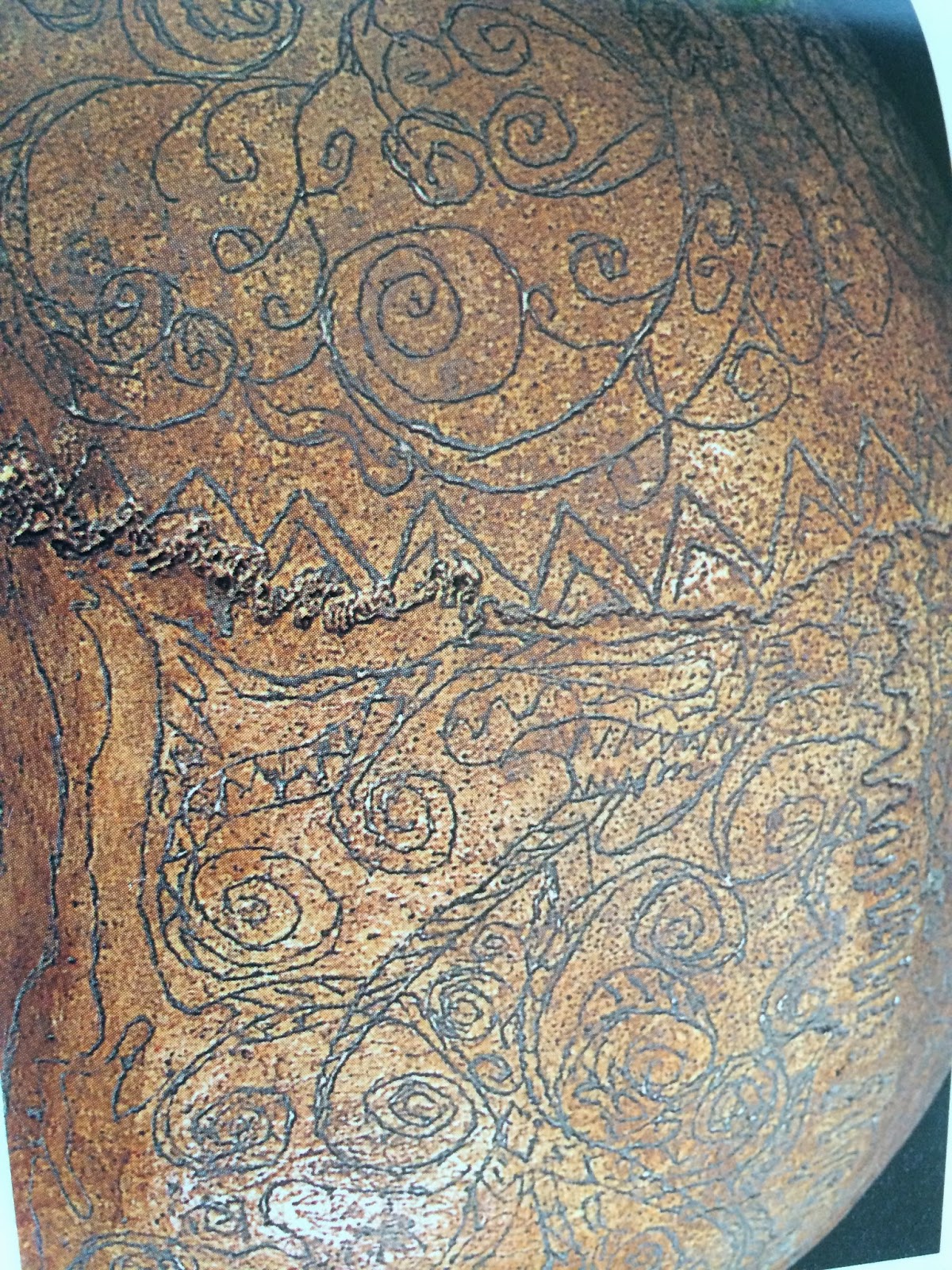
Closeup of the skull showing intricate patterns

Headhunting is deeply rooted in the SEA ritual life and a person who has taken heads gained stature in the community. Also, in some warrior communities, it was a 'coming of age' for a boy. A boy had to prove that he was a man and could only marry if he had taken at least one head. Headhunting has been banned for over 100 years in Borneo, however it is so deeply entrenched in the lives and folklore of the Dayaks that mock raids and rituals are still practiced; but luckily for tourists, a coconut is used to symbolize a head. There have been some rumours in the 20th century about headhunting incidents especially during world war II and also some cases reported in the Indonesian papers as recently as 2001. 

Saturday, August 23, 2014

Qur'an Ghubari scroll

Qur'an scroll fromTurkey, 15 CE. ACM, Singapore


Close up of the Qur'an scroll, 14 x 112 cm
If there was a fire in the museum, which artifact would I save? Tough question since there are so many beautiful artifacts in the museum but hands down, it would have to be a 500 year old Qur’an scroll written in ghubar script. The scroll measures 112cm x 14 cm and amazingly, it contains the entire contents of the holy book of the Muslims, the Qur’an.

The holy Qur’an contains God’s revelations to Prophet Muhammad in the 7th CE and literally means recitation. It comprises of more than 77 thousand words in Arabic and they are all contained here, in a space measuring just over 1 meter. What you can see from far is a popular Shi’ite invocation but on closer inspection (click on the pictures to enlarge them), you can see minuscule words entirely handwritten in an Arabic calligraphic script called ghubar, which in Arabic means dustlike. The letters are as tiny and delicate as dust, often measuring between 1.3 and 3mm, like an army of tiny ants on paper. The ghubar script was probably first developed to convey military messages via carrier pigeons or pigeon post - olden day courier service!

What I find absolutely fascinating is the skill of the calligrapher who has painstakingly written this scroll. I can’t imagine the number of hours spent practicing and planning it and since it contains the sacred words, there can be no mistakes. Traditional tools used by Arabic calligraphers are carbon-based black ink, a reed pen called qalam and paper. The qalam is hand-cut by the calligrapher at an ergonomic angle and is slit down the center to hold ink. The width of the reed pen used to write ghubari is so small, barely visible to the naked eye.

Qalam made of reed used by Arabic calligraphers
There is a story that I like to tell the visitors. A 15th CE calligrapher eager to impress the ruler Timur (also known as Tamerlane) presented him with a miniature ghubari Qur'an that was so tiny that it could fit under a signet ring. You would think that the great ruler would be impressed, but it was not so. The calligrapher then made a Qur'an so large that it needed to be carried in a cart and for this, he was handsomely rewarded.

The ghubari script is too small to be read so the purpose of the scroll is as a talisman, since the words of God are believed to have protective powers. Ghubari miniature Qur’an were mainly commissioned for their portability and some were put into cases that were worn either around the neck or around the arm. Out of respect for the sacred words, they would have to be worn above the waist.

Miniature Qur'an from Persia or Anatolia, 14 CE (7 x 4.9 cm). ACM, Singapore
After looking at these Qur'ans, you realize why Arabic calligraphy is considered the highest art form in the Islamic world.


Sunday, August 17, 2014

Introduction

'Hello, my name is Pritika and I am a volunteer at the museum. I'm originally from India but have lived in Oman, the US and now here.' This is my standard introduction before starting a tour at the Asian civilisations museum (ACM), Singapore.

Incase you are wondering who a docent is, it's a volunteer tour guide who has to bring artifacts in the museum to life and hold the visitors interest for an hour.

Its been a two year journey of discovery into a new life as a docent and I love every moment of it. I had a passion for art and now a new found love for anthropology (incidently, I also love the anthropologie stores in the US). I find it stimulating to interact with people from different countries and at the end of the tour, hopefully they leave with a greater understanding of Asian artifacts and the society that flourished in Asia.

As you can imagine, there is a fair amount of research that is required to become a docent since you have to be able to speak intelligently about an artifact and answer questions on the spur of the moment. I thought it would be a great idea to share my discoveries with the wider community and therefore am embarking on writing a blog. I will primarily write about artifacts that are in the ACM and some of the docents who bring it to life, so watch this space!

Just to set expectations, this is not a blog that is suppose to contain erudite research, but its for the general public who is probably not very familiar with historical events or doesn't have an art background. All the posts will contain information that is public but having said that, I will check sources and list them for most posts.

You can visit the ACM website to check the latest exhibitions at www.acm.com.sg. The museum celebrate the peoples who have helped in shaping Singapore into the cosmopolitan hub that it is today. The collection has artifacts from South Asia, China, South-east Asia and West Asia...lots to explore so if you are in the neighbourhood, do drop in.

Entrance to the ACM